
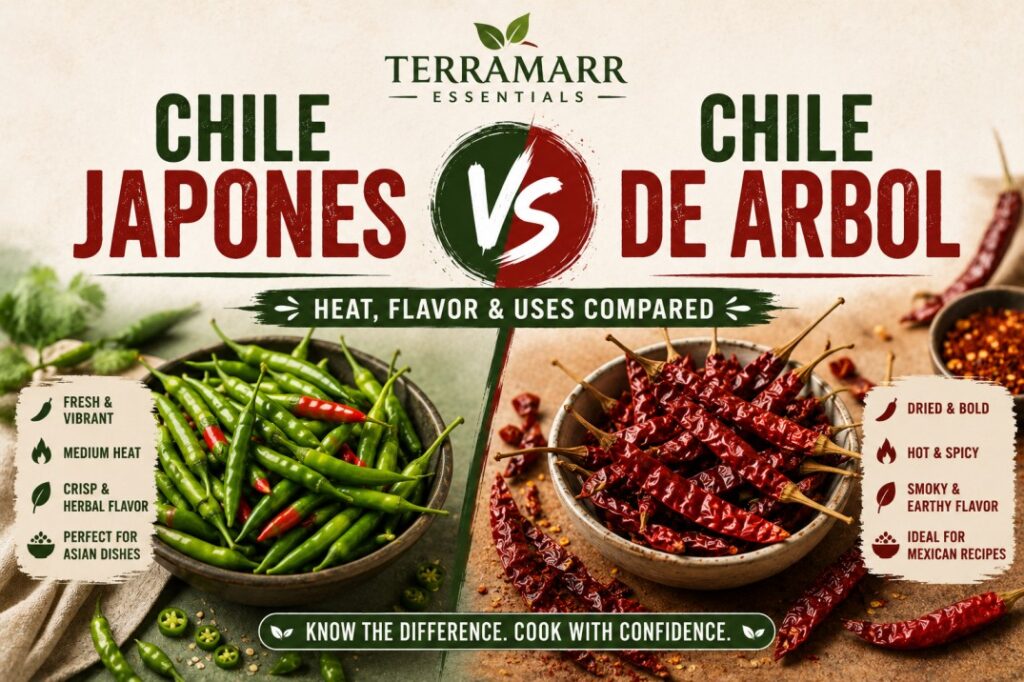
Chile japones and Chile de arbol are small, dried red peppers known for their intense heat, as they have similar levels of heat, which makes them a great option for people who love spicy food. However, there are many options available; when it comes to adding heat and flavours to Mexican cuisine, no one can ignore chile japones and chile de arbol. They have different flavours and culinary uses, but they can be used as a substitute for one another. Both peppers are well known for adding a spicy tang to your sauces, soups, salsas, and many more. Chile Japones are flat in shape, whereas Chile Arbol are slightly curved. The majority of people get confused between chile de arbol and chile japones.In this blog, we will discuss chile japones vs Chile de Arbol.
Chile de Arbol: These originate from Jalisco(Mexico’s Western Coast). They are smaller in size(measuring 2-3 inches), and they are best known for their intense heat and their nutty taste. Just like other chiles, chile de arbol also grows on bushy plants. It is basically used in Mexican cuisine. They can be used dry as well as fresh. However, people prefer dried chile de arbol as it elevates the simple dish by introducing complex flavours. Its ancient name is cuauhchīlli, which stands for “wood” and “chilli”.Their heat is between 15,000 and 30,000 SHU.
Chile Japones: These originate from Mexico, but they are highly used by Asian people (mainly in Chinese, Korean, and Japanese cuisines). They contain a natural compound called capsaicin, which is rich in Vitamin A and C and also helps in boosting metabolism. Chile Japones is also referred to as Santaka or Oriental chilli. Sweeter in taste and also less smoky than Chile de Arbol. However, its name is Chile Japones, but it is mainly related to Mexican and asian cuisines. It has the same heat content as Chile Japones, i.e., 15,000- 30,000 SHU.
| Content | Chile de Arbol | Chile Japones |
| Place of origin | Jalisco(Mexico) | Mexico(later it was adopted by asians) |
| Size | 2-3 Inches | 2-4 inches |
| Heat | 15,000-30,000 SHU | 15,000-30,000 SHU |
| Color | Bright Red | Deep red |
| Commonly used for | Hot sauces, Salsas, soups, and stews | Chutneys, salsas, and stir-fries |
| Flavour | Nutty and smoky | Less smoky and faintly sweet |
| Shape | Thin and Curved | Wide and Flat |
Yes(Sí), we can use Chile japones instead of chile de arbol or vice versa, as they both have the same heat levels (15,000-30,000 SHU). But both have different tastes, Chile de arbol has a slightly smoky and nutty taste, while Chile Japones has a less smoky and faintly sweet taste. So, you can substitute these two and turn your standard dish into a signature dish. (Sí, puedes usar chile japonés en lugar de chile de árbol, y viceversa, ya que ambos tienen un nivel de picante similar de entre 15,000 y 30,000 unidades Scoville). Pero ambos tienen sabores diferentes. El chile de árbol tiene un sabor ligeramente ahumado y a nuez, mientras que el chile japonés tiene un sabor menos ahumado y ligeramente dulce.
Many people often ask, ¿Qué tan picante es el chile japonés? (How spicy is the Japanese chilli pepper?) – Chile Japones comes under the category of medium-hot chilli, as its heat range is between 15,000 and 30,000 Scoville Heat Units (SHU). They are spicier than standard Japones(heat range 2,500 – 8,000 SHU).(El Chile Japonés entra en la categoría de chile medianamente picante, ya que su rango de picor está entre 15,000 y 30,000 Unidades de Calor Scoville. Son más picantes que los Japones estándar (rango de picor de 2,500 a 8,000).
This blog is based on the information regarding Chile Japones vs Chile de Arbol. These two chillis are commonly used in Mexican cuisine; however, Chile japones is also used in some Asian Cuisines as well. If you want to add flavours and spices to your standard dish, then you don’t need to go anywhere, as we, Terramar Essentials USA, provide dried peppers. We deliver the authentic flavours that will not only enhance the taste of your food but also refresh your mood. If you want to buy dried peppers at wholesale prices, you can contact us. Apart from spices and peppers, we supply plastic products and poly bags wholesale.