There are many types of printing paper on the market that are made for many purposes. You might have already seen and know the names of normal printing paper or thermal printing paper. The reasons why they are made in these different ways are due to the many printing methods and their characteristics. In this guide, we’ll discuss thermal printer paper vs regular paper.
Thermal paper or heat-sensitive paper is a specialized type of paper coated with a chemical sensitive to heat. The invisible chemical is composed of dyes and developers, which, at a high temperature, react and cause the paper to turn black. Thermal printers usually print by using a thermal print head, heated up and pressed against the paper, triggering a chemical reaction in the form of image/text on the paper. This method is directly called thermal printing.
Thermal paper is commonly used in point-of-sale devices like card terminals, cash registers, label printers, fax machines, and other types of thermal printers. In addition to the common use of these devices, many industries, such as health care, also rely on thermal paper technology.
Normal paper, also known as inkjet paper, is a type of paper which does not have any chemical coating. It comes from wood pulp or any other fibers from plants and it is mainly used for printing, writing, and drawing. A standard normal paper would be A4, which is very commonly used in the house and office.
Normal paper absorbs ink or toner onto its surface rather than reacting to heat like thermal paper. This simply means that if you are using a normal paper, then during the printing process, ink or toner is required, such as laser or inkjet printing.
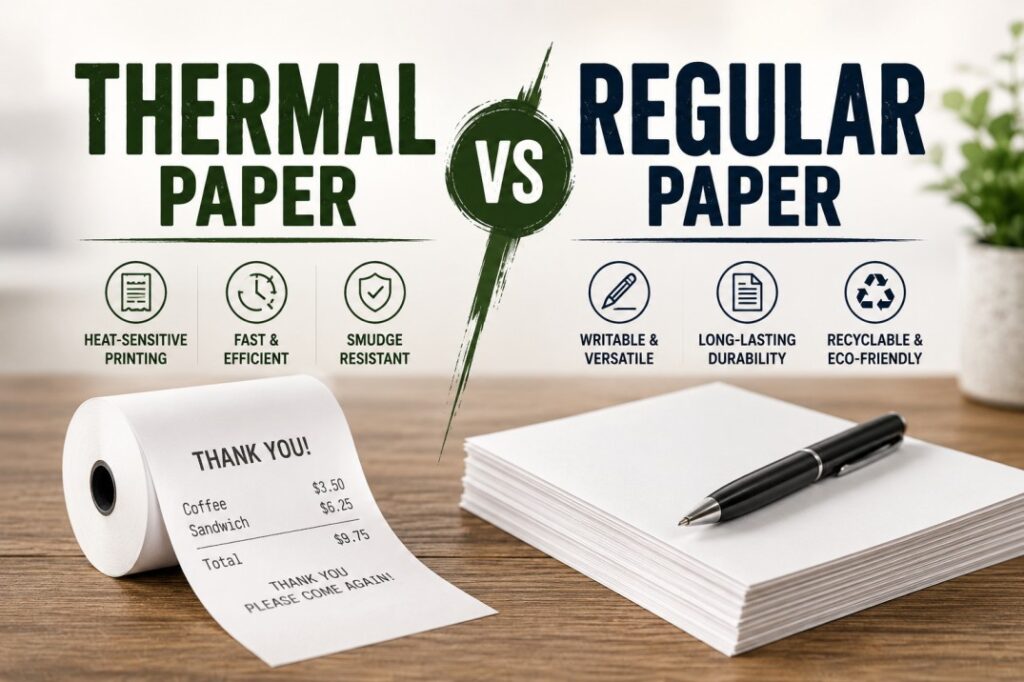
The major disparity between normal paper and thermal paper lies in the method of printing.
Feature |
Thermal Paper |
Regular Paper |
| Printing Method | Uses a thermal printer with heat-sensitive coating and printhead technology. | Uses inkjet or laser printers that transfer ink or toner onto paper. |
| Consumables Required | No ink, toner, or ribbon is required. | Requires ink cartridges, toner, or ribbons for printing. |
| Printing Speed | Faster, more efficient print system. | Comparatively slower due to ink or toner transfer process. |
| Print Quality | The print appears with clear, sharp, no smear. | Depending on the printer, prints may smear or require time to dry. |
| Maintenance | The amount of maintenance is small because there are less moving parts. | Requires regular replacement of cartridges and printer servicing. |
| Operating Cost | Lower operational costs because no consumables are needed. | Higher operational costs due to recurring ink or toner expenses. |
| Portability | Ideal for compact and portable printers such as POS systems and handheld devices. | Conventional printers are generally bulkier and less portable. |
| Noise Level | Operates quietly during printing. | Inkjet and laser printers can produce more noise. |
| Energy Efficiency | More energy-efficient and suitable for continuous operation. | Typically consumes more power during printing. |
| Common Applications | Most commonly used for receipts, barcode labels, tickets, POS, and medical scanning. | Used in everyday printing such as office documents, reports, books etc. |
| Suitability for High-Volume Printing | Good for high volume environments with less down time. | High volume printing job may have been stopped for too frequent replacing cartridges. |
| Downtime | Very little downtime as no ink or toner cartridges to refill. | More downtime due to maintenance and consumable replacement. |
Thermal paper and regular paper differ mainly in their printing methods and applications. Regular paper works best in an office and daily printing use, but thermal paper is quieter, faster, and more economical for printing, since it has no ink or toner for printing. Therefore, thermal paper is widely used in the business (such as receipts, POS systems), healthcare (labels), medical, etc., due to its low-maintenance, efficiency, and portability advantages. You are welcome to contact Terramar Essentials to purchase the thermal paper at wholesale price.
We also supply other kinds of paper materials at wholesale prices; the other paper materials include paper cups and plastic packaging, as well as spices and herbs. For example, we sell wholesale poly bags, shrink wrap, and trash bags.
Other Useful Links
What is Thermal Paper Used For?