
A highly stretchable plastic film is commonly made from Linear low-density polyethylene. It is commonly used to wrap different items. The flexibility of this plastic keeps the products tightly bound. Stretch film wraps items on pallets and secures them to each other and the pallet. It helps reduce product loss, reduce worker injury, and discourage load tampering. In this blog post, we’ll discuss how to use heavy duty plastic wrap for pallets. There are different thicknesses, widths, and types of stretch film.
Stretch film is important for wrapping pallets. Many consumers don’t realize that plastic stretch film plays an important role in delivering and transporting most products they use, display, eat, and store. There are different types of products that a stretch wrap can be used on.
Pallet wrap, also known as stretch film, is commonly made from Linear Low-Density Polythylene (LLDPE). This plastic is known for its puncture resistance, high elasticity, and ability to cling to itself without adhesives. It is primarily used to protect, stabilize, and secure products on pallets during shipping and storage.
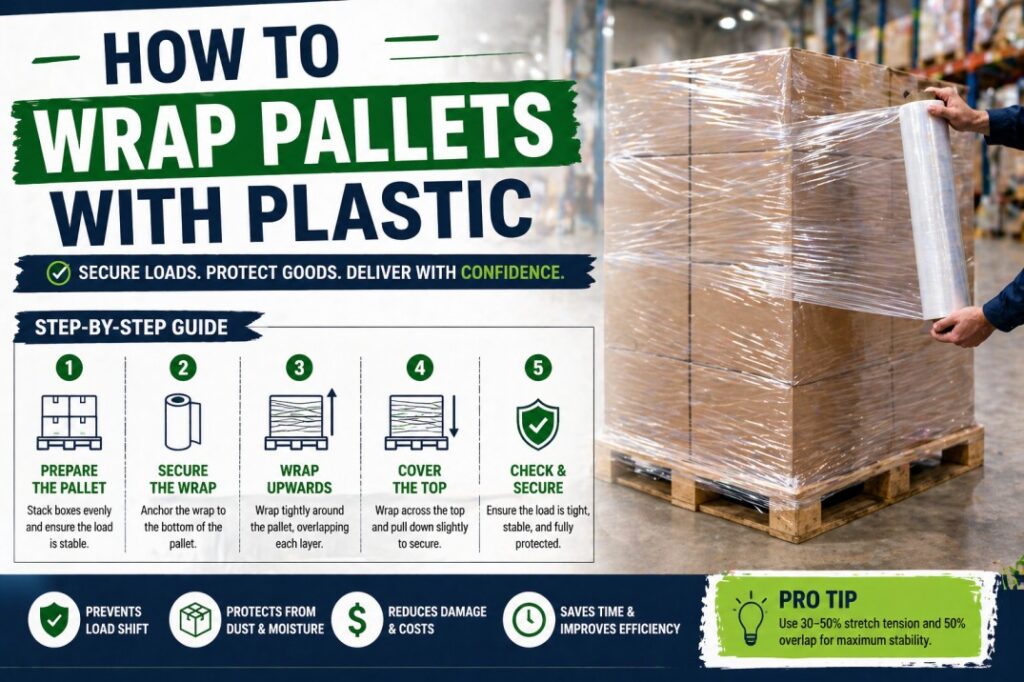
It’s a quick and tricky process to wrap a pallet with plastic. Here’s the breakdown to know how you can easily wrap pallets:
You need to use a pallet that has a good shape. Make sure that it is sturdy without any splitting edges or broken boards, and that it has the right size to accommodate your goods.
Now, you are required to stack your goods on your pallet as close together as possible. If they have space to shift after being wrapped, it will loosen the pallet wrap, which can make the load unstable and increase the risk of damaged items. If you are unable to remove gaps between goods, then it’s advisable to use anti-slip layer sheets between the layers to prevent movement. Make sure to pay close attention to the way you are layering your products. Make sure to place heavier, larger goods at the bottom and stack smaller ones on the top. You need to ensure that the items are within the boundaries of the pallet to minimize the risk of change in shipping.
You need to choose your pallet wrap, like a pre-stretched film. You can also use a perforated wrap. Remove a couple of feet of pallet wrap film from the roll. Squeeze around 8 inches of the end of the film into a loose rope, thread it through, and around a corner of your pallet. Make sure to tie it securely.
Wrap a stretch film around the bottom of the pallet while keeping consistent stretch on the film. You need to wrap it securely to ensure stability and avoid anything falling off. You can wrap the stretch film at least 4 times around the bottom of the pallet to keep it tight around the corners.
You need to consider the way of your wrapping. Make sure each layer overlaps the previous one. When you reach the top, start checking your way back down again if required to make the load stable.
After completing the wrapping, tear the wrap and stick the end to the pallet or tuck it under one of the pallet’s edges.
Finally, it’s time to check the load stability to ensure that goods won’t shift in transit. You know you are done if you push the top items and they are not loose.
Both shrink wrap and stretch wrap are recyclable. You can check with your local recycling center to ensure that they accept soft plastics. If you are interested in buying shrink wrap, you can contact Terramar Essentials, as we work closely with reliable shrink wrap suppliers for quality products.
Usually, a stretch wrap holds boxes and products together on a pallet for shipping. It is also used to secure other goods together and protect them during transport and storage. It comes in a variety of specialty wraps. Some examples include UV stretch film, anti-static stretch film, colored stretch film, vented pallet wrap, etc.
Wrapping a pallet is a crucial process that needs precision and concentration. When performed accurately, wrapping a pallet can keep your items secure during transit and maintain an organized warehouse space. With the information given above, you can easily wrap a pallet and ensure that every pallet is wrapped perfectly. Moreover, if you are interested in buying plastic packaging products, you can contact Terramar Essentials, as we supply plastic bags, shrink wraps, and many other products.